
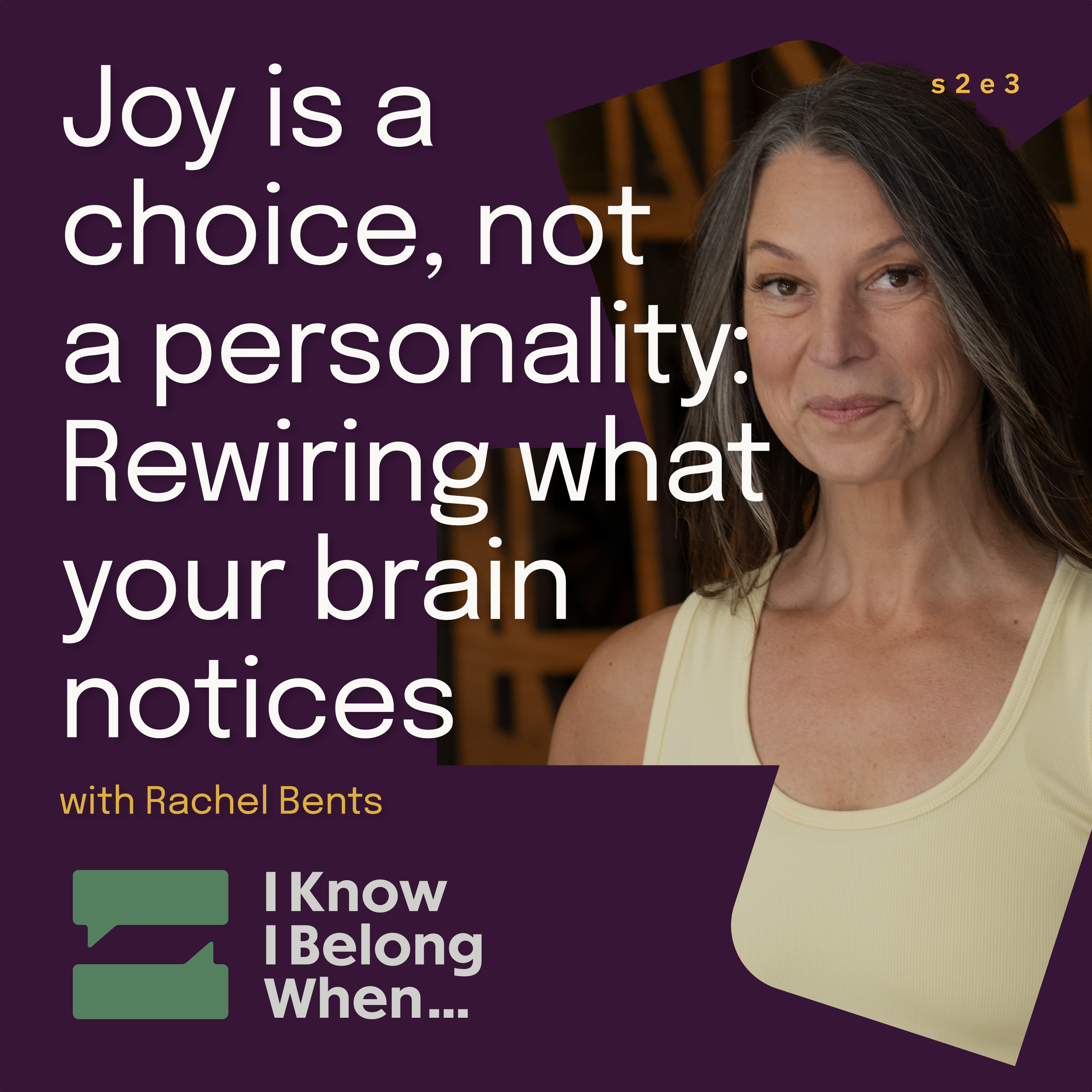
Joy is a choice, not a personality: Rewiring what your brain notices with Rachel Bents
Engage through your podcast player of choice!
Joy is not a personality trait handed out at birth. It is a practice, it is available in the middle of a hard season, and Rachel Bents can explain the biology of how it works.
In this episode of I Know I Belong When…, Rachel Bents joins host, Christopher Bylone, for a conversation about what changes when joy stops being the reward at the end of the work and becomes the thing that makes the work possible. Rachel is the founder of The Joy Collective, the author of Joy Is the Strategy, and the creator of the ENJOY Method, a framework grounded in wellness, connection, giving, and purpose. She hosts the Joy Unfiltered podcast and holds two master's degrees, in education and kinesiology.
What gives this conversation its weight is where Rachel locates her own belonging, and where she lost it. She did not know she belonged in a room somebody else designed. She knew it in a community she created almost by accident in her fifties, when roughly five hundred people joined a joy membership she had started on a whim. She knew the opposite at a four-person consulting firm, at the table where leadership was rewriting its values, when she proposed fun as one of them and the chief executive dismissed it in a single sentence. That night she told her husband she needed a new job, whatever the salary.
This is belonging as a whole-life reality: in the version of yourself nobody else is present for, in the communities you choose, in recovery rooms, and in a workplace where one sentence can tell a person they are finished there.
Watch the full episode :
Must-hear insights & key moments
Why joy remains available in a hard season, and the difference between choosing joy and pretending nothing is wrong
The eleven million bits of information arriving in your brain every second, and how the filter that sorts them can be retrained
The moment Rachel knew she belonged: a joy membership started as a lark, five hundred members, and the exhale that followed
The sentence from a chief executive that ended a job Rachel liked, and the non-negotiable values she wrote because of it
How she reworked the interview into a two-way conversation once she understood that an employer does not hold all the power
What recovery rooms taught her about shared humanity, and the breath she takes before entering any room
Her thirty-second practice for retraining attention: notice, allow, share
Rachel’s standout quotes:
"So joy is always available. I think that is the first thing for people to recognize."
"it is our brains, and we can train our brains to filter for joy"
"All of a sudden, I had five hundred people like, I don't know, a couple of months join this joy membership, and I thought, 'Oh, these are my people.'"
"I was finally in my fifties learning these are my gifts, and I can fully exhale."
"it was like somebody turned the light on and said, 'You do not belong here.'"
"I don't care how much money they're paying me, I need a new job."
"I'm in recovery. and I think what those rooms taught me was that I am no different than anybody else."
Why this episode matters
Most conversations about joy stop at encouragement. This one does not. Rachel describes the mechanism, names what it cost her to remain somewhere her values were dismissed, and gives listeners language for the difference between a room that tolerates a person and a room where that person knows they belong. Her answer to the closing question refuses the premise of the show's own sentence.
Who should listen
Anyone working out who they are and what they are for. Parents and people building a home or a chosen family. Students, educators, and anyone earning a credential later in life. Community builders, organizers, and people in recovery. HR leaders, people managers, and anyone practicing strategic inclusion or building an inclusive culture across remote and hybrid teams. And anyone searching for language to name a sense of belonging in everyday life, well past the workplace.