
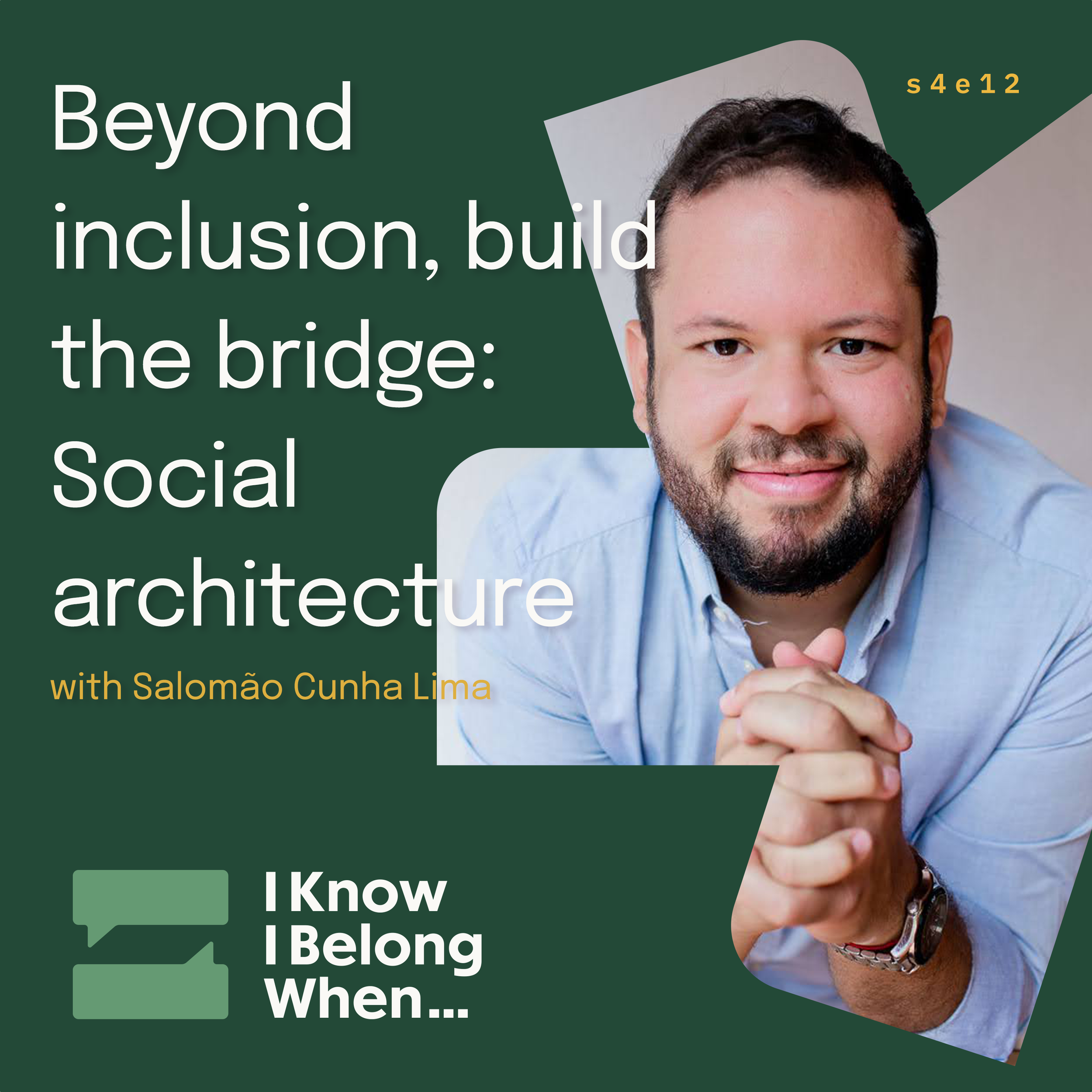
Beyond inclusion, build the bridge: Social architecture with Salomão Cunha Lima
Engage through your podcast player of choice!
Some people wait for a door to open. Salomão Cunha Lima decided the room needed to be built.
In this episode of I Know I Belong When…, host, Christopher Bylone, is joined by Salomão Cunha Lima, founder and CEO of Sal&Co, a Social Architecture Lab in São Paulo, Brazil. The conversation moves through every arena of a life: self, home, community, work, and society.
Salomão calls his work social architecture rather than social impact, and the difference is structural. On one side is a company. On the other is a community. Neither side changes shape. The work is designing something strong enough for both to cross and durable enough to outlast the announcement. Across eighteen years in Latin America he has mobilized more than two million dollars in corporate partnerships for clients including BMW, Disney, and Deloitte.
He also makes an argument here that reorders two words people often treat as interchangeable. Inclusion, he says, carries a hierarchy inside it. Someone grants, and someone receives. A sense of belonging works differently, and it begins with permission a person gives to themselves.
This is a conversation about inclusive culture, authentic leadership, and human-centered innovation. It is equally about faith, a name he almost surrendered for the convenience of strangers, and what a person does when no existing room will hold them.
Watch the full episode :
Must-hear insights & key moments
Why social architecture is a bridge rather than a program, and why the design has to account for who will cross it
The distinction between inclusion and belonging, and why one of them requires someone else’s permission
The story of his name, opened three times from a Bible, and the stranger in Las Vegas who told him to stop making it easy for everyone else
How GAMES began: government affairs, media, entrepreneurs, and supporters, built because no room like it existed
The church that asked him to stand before the congregation and ask forgiveness, and the answer he gave instead
What he practices inside his own small company, including naming his own overwhelm out loud instead of assigning fault
His single call to action, which is smaller and harder than it sounds
Salomão’s standout quotes:
"So for me to be included, I need the permission of others to include me"
"there is no place where I feel I belong, that I can bring my authentic self"
"So if I don't find a place where I belong, so let me try to build this place"
"I didn't do anything wrong with anyone here. I'm not gonna do it."
"from that moment, I just understood that I had the strength to say no to some environments"
"it's about self-esteem, it's about self-love, it's about self-respect"
"believe in yourself, but if sometimes you don't have the strength to move forward, just stop and raise the hand and ask for help"
"When I am in a place where I can smile, feel myself at home, and know that I own the party"
Why this episode matters
Most conversations about strategic inclusion stop at the office door. This one does not. Salomão traces a single practice across a childhood in northeast Brazil, a faith, a corporate career, and a country where the fight is far from settled. The through line is that he stopped waiting for a place to be offered and started building places instead. For anyone working out how belonging actually gets made rather than announced, this is building belonging with structure behind it.
Who should listen
Anyone working out who they are and what they add to the rooms they enter. Parents and people building a home or a chosen family. Community builders, organizers, and people of faith holding a question about whether both can be true at once. HR leaders, people managers, and inclusion practitioners looking for language that holds up outside a training deck. Founders and consultants designing partnerships that outlast a press release. And anyone searching for words to name belonging in everyday life.