
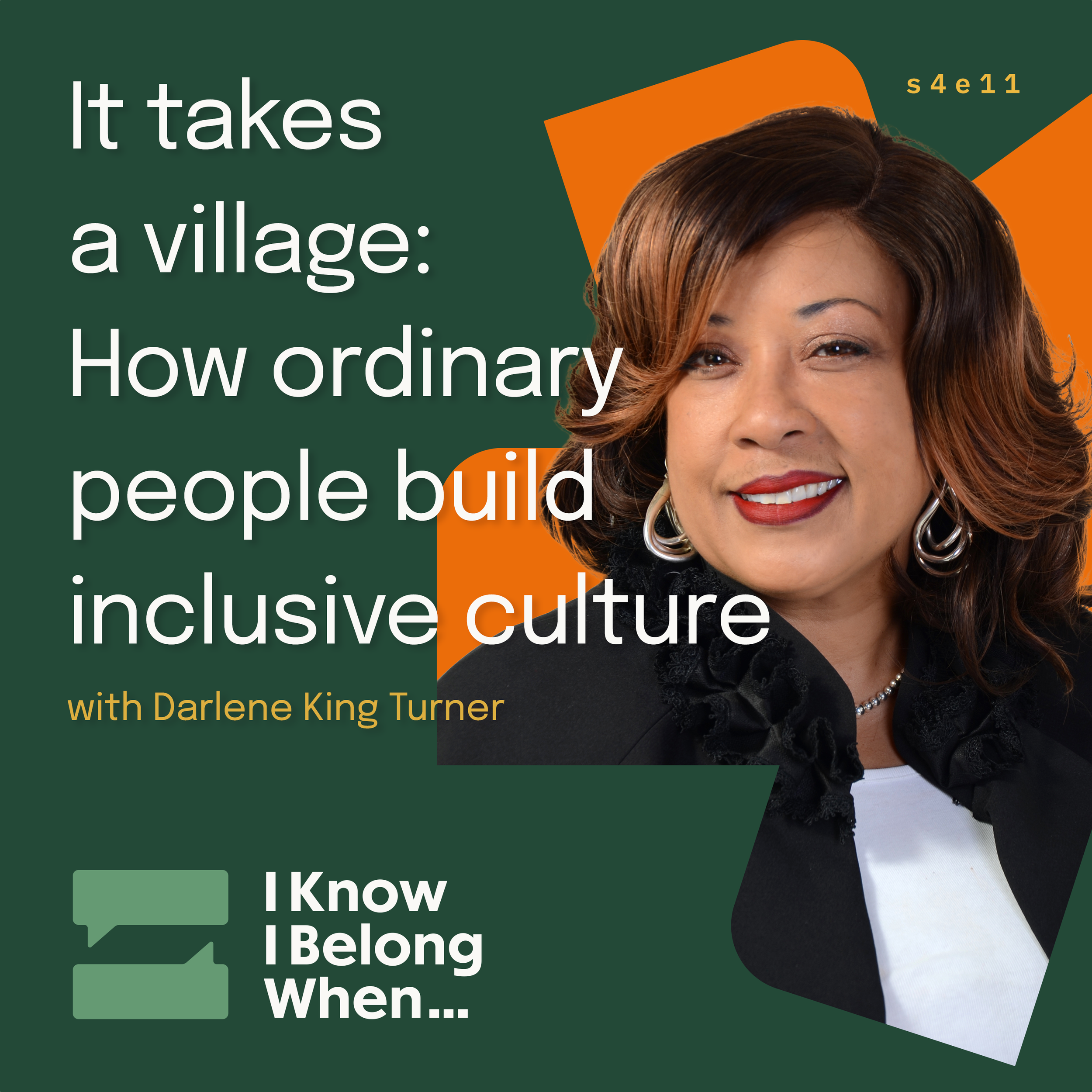
It takes a village: how ordinary people build inclusive culture with Darlene King Turner
Engage through your podcast player of choice!
Belonging is not a program that gets rolled out at work. It is the durable knowledge that who you are is enough, and it has to hold at home, in your community, and in the wider society, not only in a conference room.
In this episode of I Know I Belong When…, Darlene King Turner joins host, Christopher Bylone, for a conversation that refuses to keep belonging inside the workplace. Darlene is CEO and president of the Unity Collaborative, where she designs strategic initiatives that dismantle systemic barriers for businesses, youth, families, and whole communities at once. She led the Michigan Diversity Council for ten years, and before that she directed training and development for all thirty-four school districts in Wayne County. Before any of that, she spent six years as a national concert promoter, touring the world and producing shows across Detroit. She learned to fill a room long before she learned to change one.
Her central claim arrives early, and it reframes everything after it. Belonging does not belong to an institution or an entity. It belongs to every living, breathing person. No degree and no title is required to create a space where another person knows they belong. That is true for a chief executive, and it is just as true for a student, a neighbor, and a store clerk.
Watch the full episode :
Must-hear insights & key moments
Why building belonging is engineered rather than announced, and what twenty-five years of strategic inclusion taught Darlene about making it hold.
The story her name carries: parents who migrated from the segregated South, and a grandmother who raised twelve children and bought her home without ever holding a formal job.
The moment Darlene knew she belonged, in a room that held both General Colin Powell and President Barack Obama early in her career, and what she noticed about every other person there.
The moment she knew she no longer belonged, when new leadership pushed her out after ten strong years, and the reversal when thirty-four organizations left with her and asked her to build something new.
Representation as strategy, including the statistic behind the National Black Men in Leadership Conference and the seventeen-year-old whose response gave this episode its title.
Creating belonging in everyday life, at the grocery store, the gas station, and on the bus, where authentic leadership shows up with no audience and no job title attached.
Darlene’s standout quotes:
“We all carry the ability to create spaces of belonging.”
“if you don’t know where you came from, then you really don’t know where you’re going”
“It wasn’t by luck or happenstance. It was where I was destined to be.”
“I knew I belonged. I knew. I just knew it.”
“the light comes out of the darkest moments.”
“it is everyone’s job no matter where you are.”
“I know that I belong when I feel safe.”
Why this episode matters
Belonging is the outcome of inclusion, diversity, equity, and accessibility working together, not one more pillar on a list. Darlene shows what that outcome asks of people in practice: cross-sector partnerships, representation a young person can recognize, and human-centered innovation in the smallest daily exchanges. Her story also names the real cost when a structure turns on a person. Listeners leave with language for belonging they can carry into a boardroom, a school district, a living room, or a checkout line.
Who should listen
This conversation reaches every arena of a life. Anyone working out who they are and what they carry. Parents, partners, and people building a home or a chosen family. Community builders, organizers, educators, and people of faith. HR leaders, people managers, and people experience practitioners working on belonging in the workplace and inclusive culture in remote and hybrid teams. Anyone searching for words to name a sense of belonging in their own life. Everyone here has a reason to listen, not only people leaders.