
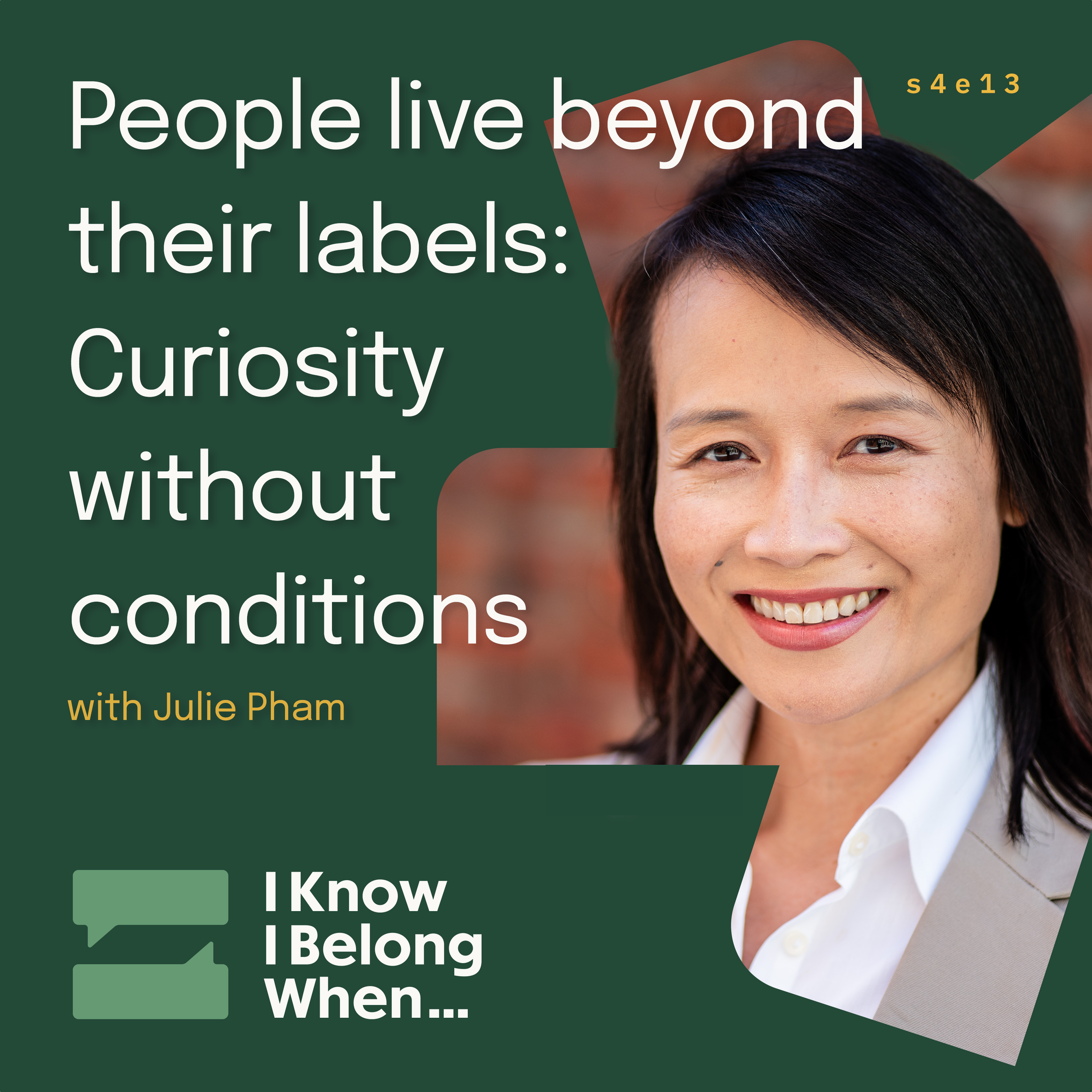
People live beyond their labels: Curiosity without conditions with Julie Pham
Engage through your podcast player of choice!
The room where Julie Pham knew she belonged held none of her credentials. No Cambridge doctorate. No Gates scholarship. No bestseller list. It was a prison, and nobody inside knew who she was on paper.
Dr. Julie Pham is the founder and CEO of CuriosityBased, and she joins host Christopher Bylone for a conversation that travels from a refugee family’s naming decision, to a correctional facility, to a weekly team meeting where a third of the agenda goes to how everyone is actually doing. Her argument is simple and inconvenient. Curiosity is a practice rather than a personality trait. It can be learned, named, and shared, and nobody gets to opt out.
This episode of I Know I Belong When… is about what happens when the labels come off. Julie walked into Washington Corrections Center through the nonprofit Defy Ventures and sat across from men serving time for serious crimes. She arrived carrying assumptions. She left understanding that people hold lives far larger than the worst thing they have done, and she has asked ever since where the edges of our compassion sit.
She also reframes code switching as strategic communication rather than loss, names the moments her work was not counted as real work, and offers one question worth asking a colleague this week.
Building belonging is not a program bolted onto a culture deck. It is something a person knows, across self, home, community, work, and society. This conversation gives language for all five.
Watch the full episode :
Must-hear insights & key moments
Julie is her American name. Hoai is the name she was born with, and it means to remember one’s homeland. Her parents chose it in 1978, after her father spent three years in a reeducation camp and the family knew they would leave Vietnam for good.
Why "What is your real name?" misses the person, and what to ask instead.
Code switching as a choice rather than a cost, and why Julie calls it strategic communication.
The prison visit that changed how she hears a neighborhood notice, a news story, and a person she disagrees with.
Three moments of non-belonging in one organization: relationship building treated as socializing, an email thread that went silent after she spoke, and paper lanterns above her desk that a team complained about for years without telling her.
The highs and lows ritual her team runs weekly, why the lows come from outside work, and what it does to hard conversations later.
The question she wants every listener to carry into their next conversation, delivered word for word.
Julie’s standout quotes:
"I have to actually get curious about myself before I can ask other people questions"
"I actually think of it as strategic communication, and that we get to code switch, not that we have to."
"let the person tell you how they want to be called"
"they have lives beyond their labels"
"Do I let other people change?"
"every work has value and it just requires different skill sets."
"My company is like my child. It’s an extension of who I am. It’s not just work."
Why this episode matters
Most conversations about inclusive culture stay inside the office. This one does not. The practice that helps a leader hear a quiet colleague is the same one that lets anyone see past a label, a record, or a name they cannot pronounce. Curiosity sits underneath strategic inclusion, authentic leadership, and human-centered innovation, and it is available to anyone willing to practice it out loud.
Who should listen
Anyone working out who they are and where their value lands. Immigrants, children of immigrants, and anyone carrying more than one name. Parents and people building a home or chosen family. Community builders, organizers, and anyone who cares what a second chance requires. Founders whose work is inseparable from who they are. HR leaders, people managers, and people experience practitioners building belonging in the workplace. And anyone searching for language to name belonging in everyday life.