
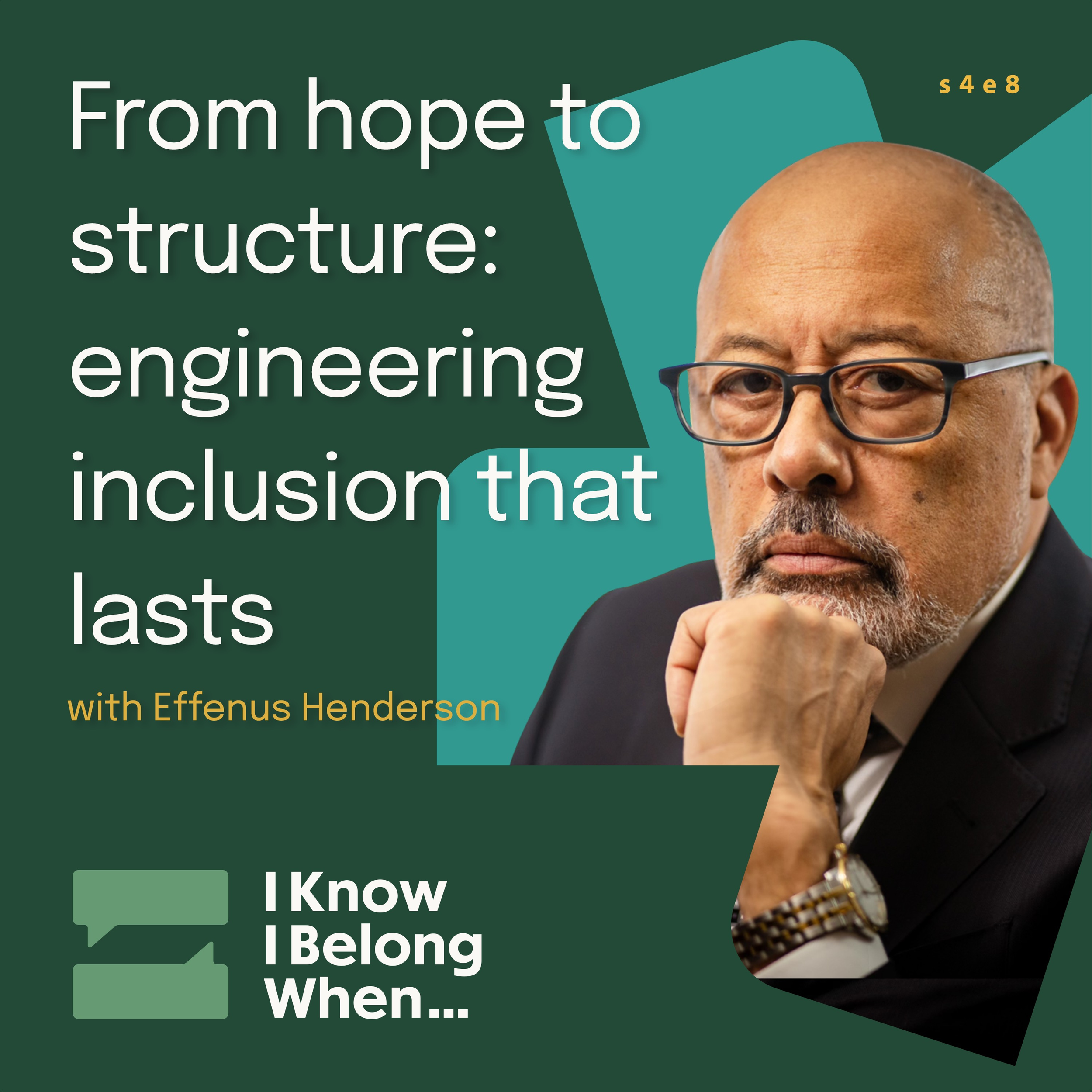
From hope to structure: engineering inclusion that lasts with Effenus Henderson
Engage through your podcast player of choice!
Most people treat inclusion like a feeling, something you hope for and revisit once a year. Effenus Henderson spent more than forty years proving it can be something you design. In this episode of I Know I Belong When…, host Christopher Bylone welcomes the president and CEO of HenderWorks, the strategist who convened the international working group behind ISO 30415, the first global standard for diversity and inclusion.
This is a conversation about belonging as a whole-life reality, not a workplace perk. Effenus traces his path from a small farm in eastern North Carolina to the General Assembly of the United Nations, where he spoke on intercultural diversity. He shows how a sense of belonging is something a person knows, not something they wait to feel, and how it grows across every arena: in who we are, in the rooms where we work, and in the wider society we all help shape.
Effenus wrote three books, including The Architecture of Inclusion, and co-founded the Institute for Sustainable Diversity and Inclusion. He has also written more than sixty original songs, because he believes equity work without a soul does not last. What emerges is authentic leadership grounded in structure and heart at once, and a language for building belonging that any listener can carry into everyday life.
Watch the full episode :
Must-hear insights & key moments
The SPINE model in plain terms: strategy, practice, ideation, need, and execution, turning good intentions into daily action.
The moment the ISO vote came back positive, and what it meant to know his language would reach workplaces in dozens of countries.
A hard early lesson in non-belonging, when a boss assumed the worst because a Black colleague arrived in a television station car.
The weekend Effenus refused a forced transfer, made his own case, and won a director role rather than accept a seat chosen for him.
His call for this moment: challenge disinformation, frame the work in the positive, and dig in rather than go quiet.s
Effenus’ standout quotes:
“I've learned how to bring more of myself to the work, bring more of myself to the community, bring more of myself to relationships so that people know who I am, they know what I am about.”
“People watch what you do, not necessarily just what you say, and they wanna see to what degree there's an alignment between what you're telling me and how you're acting and behaving.”
“People have to feel psychologically safe to share their thoughts and ideas.”
“Don't wait to be invited. Just say, ‘Hey, I think I could do that, and what do I need to prepare and do to get prepared for that?’”
“I know I belong when I find others saying that they belong as well, and can approach and work with me collaboratively in solving the problems, and that I'm being invited into those circles where it makes a difference.”
Why this episode matters
Belonging is often treated as a soft outcome, something that either happens or does not. Effenus Henderson offers a different view. He shows that belonging is the result of deliberate inclusion, diversity, equity, and accessibility work, and can be built with the rigor of any lasting structure. For anyone who has wondered how belonging differs from inclusion, this conversation gives clear language and a working blueprint. It makes the case for strategic inclusion and human-centered innovation as the way forward, not the thing to abandon.
Who should listen
This episode is for anyone building a sense of belonging in their own life, not only for people at work. It speaks to those still working out who they are, to parents and people building a home or chosen family, to community organizers and people of faith, and to anyone drawn to civic life and a fairer society. It speaks to HR leaders, people managers, and inclusion practitioners strengthening people experience and an inclusive culture. If you are searching for language to name belonging in everyday life, Effenus offers it here.