
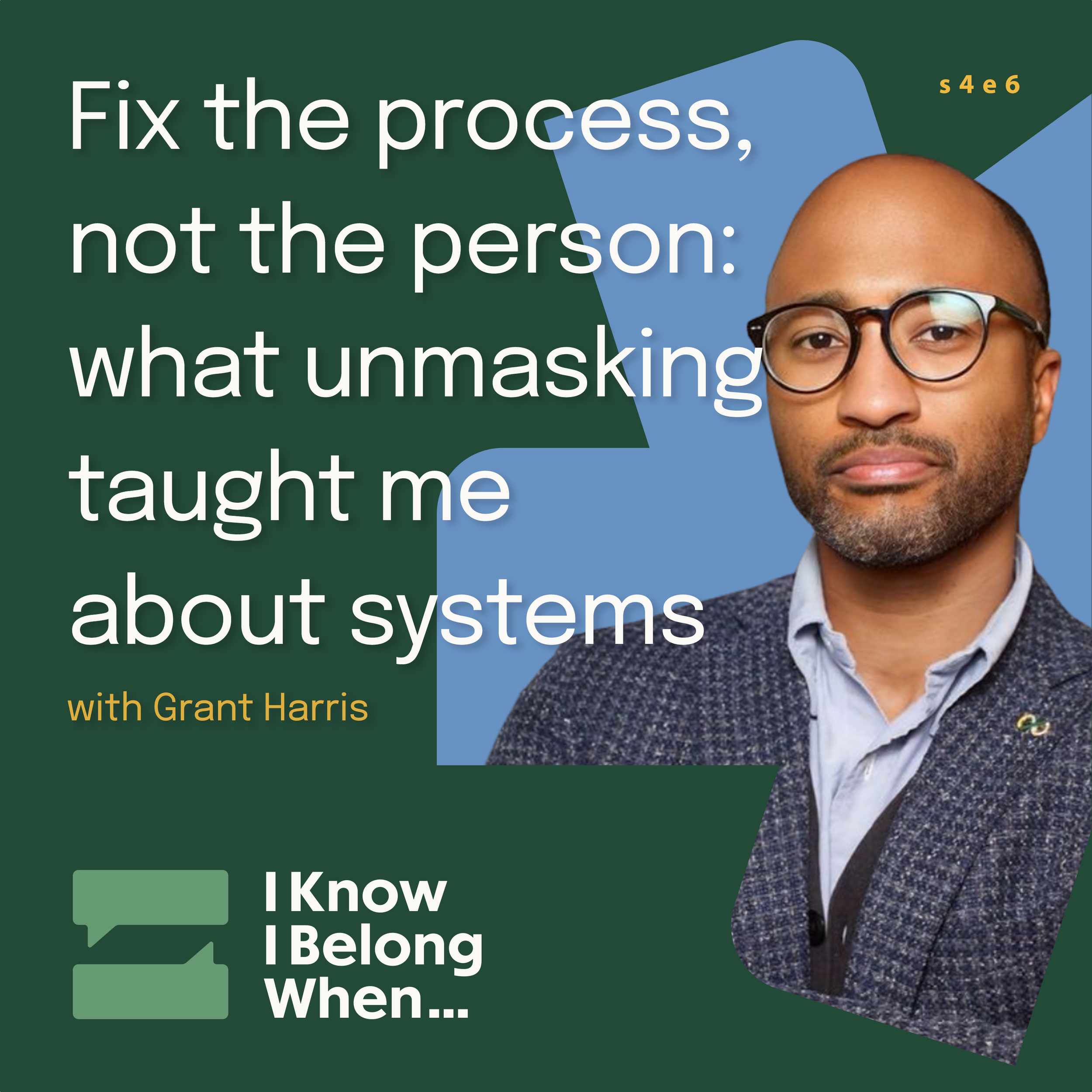
Fix the process, not the person: what unmasking taught me about systems with Grant Harris
Engage through your podcast player of choice!
What happens when a capable person stops asking what is wrong with them and starts asking what is wrong with the room around them? That question anchors this conversation, and it reaches far past any office.
In this episode of I Know I Belong When…, host Christopher Bylone welcomes Grant Harris, MBA, Certified Diversity Executive, neuro-inclusive speaker, human-centered performance strategist, and founder of GTH Consulting. Grant is known for one deceptively simple charge to leaders: fix your process, not your people. He is also a late-diagnosed autistic leader, a three-time author, a Hall of Fame athlete, and a man who has memorized every country's flag.
Grant joins Christopher to trace his own before and after, the years he spent believing he was the problem, and the moment he knew he belonged in a room full of his people. His story moves across a whole life. It lives in the self, in the quiet work of knowing who you are is enough. It lives at home and in chosen family, where the people closest to him learned how his brain actually works. It lives in community, where he found others who show up differently and know they belong anyway. And it lives at work, where he helps organizations build belonging in the workplace by redesigning the systems around people instead of labeling the people. This is a conversation about human-centered innovation, strategic inclusion, and the language for belonging that one honest story can offer.
Watch the full episode :
Must-hear insights & key moments
Why Grant reframes workplace friction as a design problem, not a people problem, and how that shift changes who gets blamed.
What a late autism diagnosis unlocked in his life, and the difference between living inside a struggle and having language for it.
The moment he knew he belonged, in front of hundreds of neurodivergent peers, and why it took him time to reach it.
How pressures from society and home follow people into work, and why leaders cannot treat the two as separate.
The difference between performing and performative, and how the wrong meeting rhythms quietly burn people out.
The one action every leader can take on Monday to catch a misread before it costs someone.
Chris’ standout quotes:
"So the external always influences the internal."
"It's not always-- it ain't always the people, uh, in the middle."
"we need to move from friction to flow."
"You don't have to do work that quickly just because I give it to you."
"Well, this is how my brain works. This is how I show up. I communicate this way. I speak this way."
"help me help you create that path."
"didn't have to consciously hide anything, didn't have to retract anything, didn't have to, hold back anything, and know that the people around me were doing the same."
"if I can be me in that environment for at least a moment... The goal is to be me all the time."
Why this episode matters
Grant offers a rare double lens. He is the strategist who teaches leaders to interrogate their systems, and he is the person those systems once misread. That pairing turns an abstract idea, belonging versus inclusion, into something you can feel. Inclusion is the work of designing fair systems. Belonging is what a person knows when those systems finally let them show up whole. This episode gives a clear way to tell the two apart, in every arena of life, not only at the office.
Who should listen
This episode is for anyone working out who they are and where they add value, especially those learning about their own neurodivergence later in life. It is for parents and partners building a home or a chosen family who want to understand a loved one. It is for community builders, organizers, and people of faith creating spaces where everyone knows they belong. And it is for HR leaders, people managers, ERG champions, and inclusion practitioners shaping people experience and inclusive culture at work. If you are searching for language to name belonging in your own life, this one is for you.