
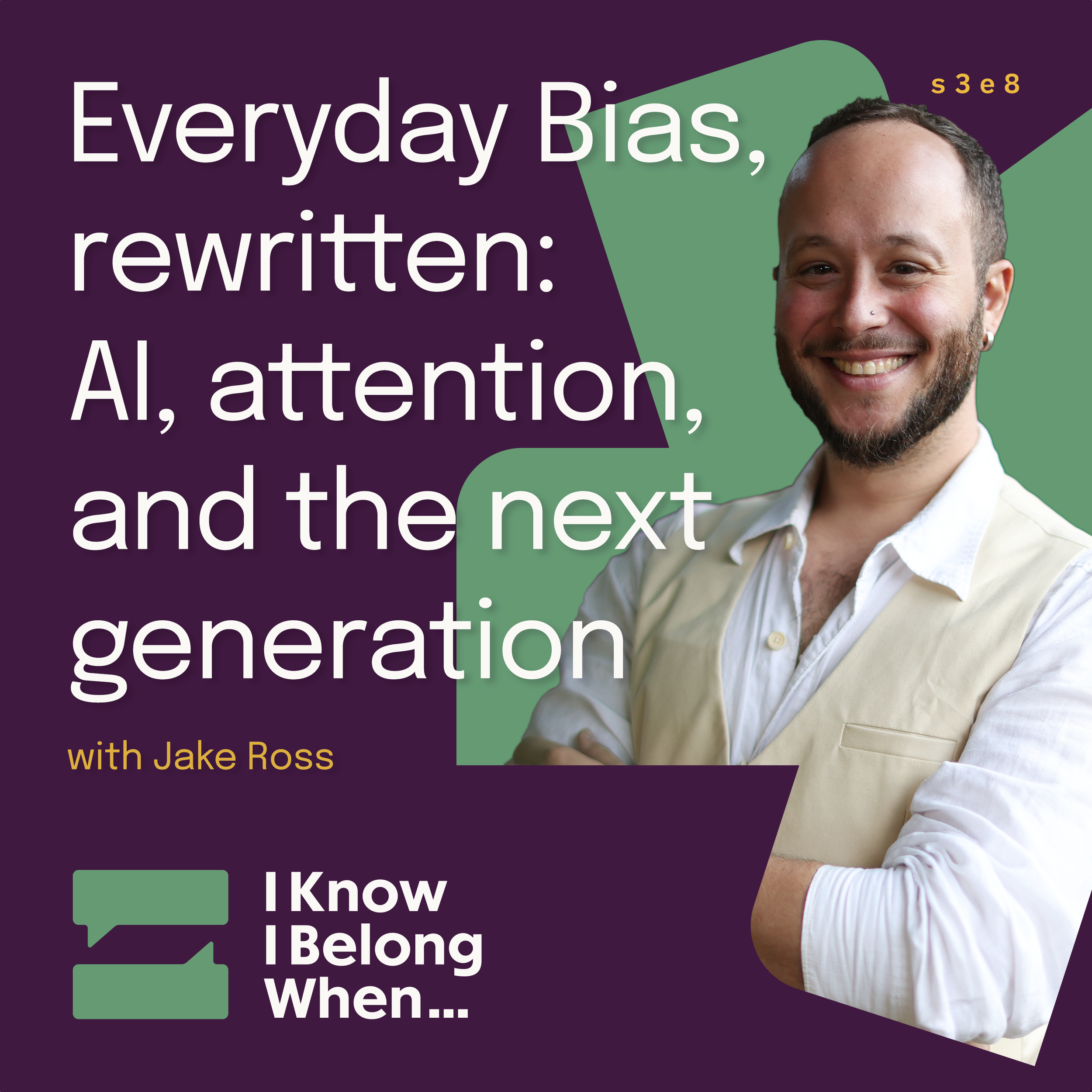
Everyday bias, rewritten: AI, attention, and the next generation with Jake Ross
Engage through your podcast player of choice!
Last week, you met the father. This week, meet the son who did not just inherit a mission. He built his own lane inside of it.
In this episode of I Know I Belong When, Christopher sits down with Jake Ross, founder and CEO of Belong Together, banjo player, former COO of an AI startup, and co-author of the second edition of Everyday Bias with his father, Howard J. Ross. Jake holds a bachelor's degree from UC Berkeley in interdisciplinary studies, a master's in applied positive psychology from the University of Pennsylvania, and a thesis called Building Belonging that reads more like a mission statement than an academic paper.
In part two of this father-and-son series, Jake brings the next-generation vantage point. His chapters in the new edition of Everyday Bias take on what most belonging conversations still avoid: the attention economy, the algorithms that decide what we see, and the emotional relationships people are quietly forming with artificial intelligence. Jake describes it all honestly, as someone who has sat on both sides of the question.
Jake also opens up about the recovery community that first showed him what belonging feels like when you cannot earn it, and the friends who see him so completely that his identity stays steady in any room.
If last week's conversation offered a half-century of perspective, this one offers the map forward.
Watch the full episode :
Must-hear insights & key moments
How a recovery community in California taught Jake what a real sense of belonging at work and in life actually feels like
Why the death of the public third place matters more now than it did when Robert Putnam first wrote about it
What the attention economy is costing us, and how algorithms quietly engineer outrage on every side of the political spectrum
The hidden cost of non-belonging inside tech teams, and why isolated builders tend to create isolating systems
Jake's father-to-colleague moment from his side of the table, and why it changed how he shows up professionally
Why the Lego collection, the banjo, and the fire dancing are not side quests; they are the practice of authentic leadership in full expression
Jake’s standout quotes:
"Belonging is not about being good enough to be in a group. It comes when you and those around you decide that you belong, simply because you do."
"When the people building those systems are lonely and not connected to their broader self, the influences of that loneliness get baked into the algorithms."
"Who we are paints the glasses."
"If I can help one person feel like they really matter, that is my life's work in action."
"I know I belong when the world around me celebrates my desire to be in full expression."
Why this episode matters
Belonging is not a soft concept, and it is not an HR initiative. It is the infrastructure of how humans show up at work, with each other, and online. Jake offers the next-generation view on what is shifting under our feet: algorithms trained to agree with us, a tech industry building interpersonal products from inside deep isolation, and a culture slowly losing its public third places. His work bridges positive psychology research and practical human-centered innovation. If you lead a remote team, a product team, or an inclusive culture strategy, Jake names what the next five years will actually require.
Who should listen
This episode is for founders and product leaders thinking seriously about bias baked into AI systems, people leaders designing inclusive culture for a hybrid and AI-augmented workplace, DEI practitioners looking for fresh language on belonging versus inclusion, positive psychology students and practitioners, HR and people experience strategists navigating belonging in remote teams, and anyone raising, mentoring, or working alongside the next generation of leaders. If last week Howard gave you the long view, this week Jake gives you the fieldwork.