
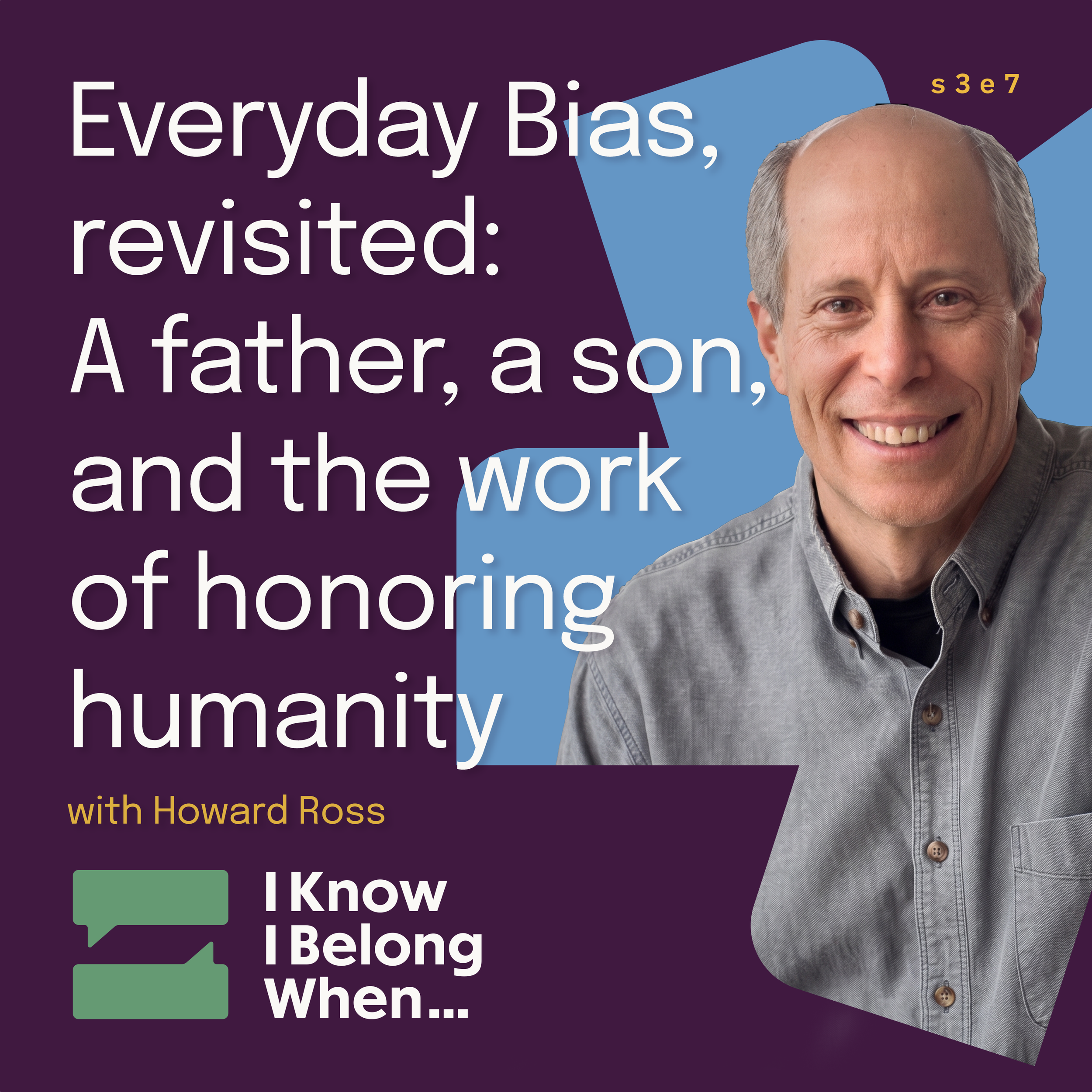
Everyday bias, revisited: A father, a son, and the work of honoring humanity with Howard Ross
Engage through your podcast player of choice!
There are practitioners who study the work. There are practitioners who live it. Then there is Howard Ross, who has spent more than fifty years standing in the middle of the conversation most people still avoid.
In this episode of I Know I Belong When, Christopher sits down with Howard J. Ross, a writer, facilitator, meditation teacher, rock and roll musician, and one of the most influential voices on unconscious bias and belonging alive today. Howard is the author of Everyday Bias and Our Search for Belonging, and he is co-writing the second edition of Everyday Bias with his son, Jake Ross, who joins the show next week in part two of this father-and-son series.
This conversation is not a victory lap. Howard is honest about the regressive moment the field is in, the places the work has missed the mark, and the patient discipline required to sustain authentic leadership when the cultural wind shifts. He shares the story of his grandfather Samuel Mash, who escaped the pogroms of Ukraine and went on to help found the Baltimore NAACP. He recalls the Nancy Neil moment that first taught him what a sense of belonging at work feels like. He describes the day in Jackson, Mississippi, in 1988 that changed how he shows up as a practitioner. And he walks through the shift from father to colleague with Jake that reshaped their work and their relationship.
If you have been searching for language for belonging, this episode is a masterclass.
Watch the full episode :
Must-hear insights & key moments
Why progress in inclusive culture always moves three steps forward and two steps back
What Howard learned from his grandfather about responsibility, legacy, and the work of honoring humanity
The Nancy Neil moment that first showed Howard what a sense of belonging at work looks like in practice
The day in Jackson, Mississippi, that changed how Howard shows up as a white practitioner in the belonging space
Why the next edition of Everyday Bias had to tackle artificial intelligence, social media, and the algorithms shaping what we see
The father-to-colleague pivot with Jake that shows how strategic inclusion begins at home
Howard’s standout quotes:
"This is going to be a long haul, and it is always going to be three steps forward, two steps back."
"Terrible things can happen, and you have a responsibility to do something about it."
"When we can see the humanity in each other, the difference becomes additive."
"I am not going to relate to you in this project as my son. I am going to relate to you as my colleague."
"Everybody needs a tribe. We have to create that bigger tent if we expect to see the change we are working on."
"I know I belong when I can be fully myself, when I can show up without having to worry that being me is going to exclude me or make my voice not matter."
Why this episode matters
Belonging is not a slogan, and it is not a program. It is the outcome of the daily, disciplined work of honoring humanity. In a moment when inclusive culture work is under open attack, Howard offers a longer view grounded in history, cognitive science, and half a century of practice. If you are rebuilding people experience strategy, navigating belonging in remote teams, or sorting out belonging versus inclusion for your organization, this episode will give you language and direction.
Who should listen
This episode is for HR and people leaders rethinking workplace belonging, DEI practitioners looking for language that still lands in the current climate, executives and founders who want strategic inclusion baked into how they lead, managers of remote and hybrid teams serious about creating belonging at work, and educators and storytellers building more human-centered innovation. If you have ever wondered what it takes to sustain belonging across a lifetime of practice, Howard Ross gives you the clearest answer you will hear this year.